Pelvic Floor Biofeedback

On Our Non-Invasive Pelvic Floor Excio Trainer

Start Your Recovery

Most people who are told to do pelvic floor exercises are given no way to know whether they are doing them correctly. Research consistently shows that up to 50% of women perform pelvic floor muscle exercises incorrectly after verbal instruction alone — bearing down instead of lifting up, contracting the wrong muscles, or holding their breath. Without feedback, weeks of effort produce little result, and patients conclude the exercises don’t work when the real problem is technique.

Biofeedback solves this. And at LPAW, we offer the most advanced pelvic floor biofeedback available in the UK — the Excio Pelvic Floor Trainer, the only unit of which in the UK is at our Bow clinic.

Physiotherapy Hydrotherapy Shockwave Sports Therapy Women's Health Dry Needling Osteopathy Pilates by Physios Babies & Children Men's Health Massage Running Assessments PTNS Post-Op Biofeedback Soft Tissue Therapy Manual Therapy Pre-Op Trigger Point Release Med-X Strengthening Physiotherapy Hydrotherapy Shockwave Sports Therapy Women's Health Dry Needling Osteopathy Pilates by Physios Babies & Children Men's Health Massage Running Assessments PTNS Post-Op Biofeedback Soft Tissue Therapy Manual Therapy Pre-Op Trigger Point Release Med-X Strengthening
What Is Biofeedback

Biofeedback is a technique in which the body’s physiological responses are measured and displayed in real time, allowing the patient to learn voluntary control over functions that are normally unconscious or poorly perceived.

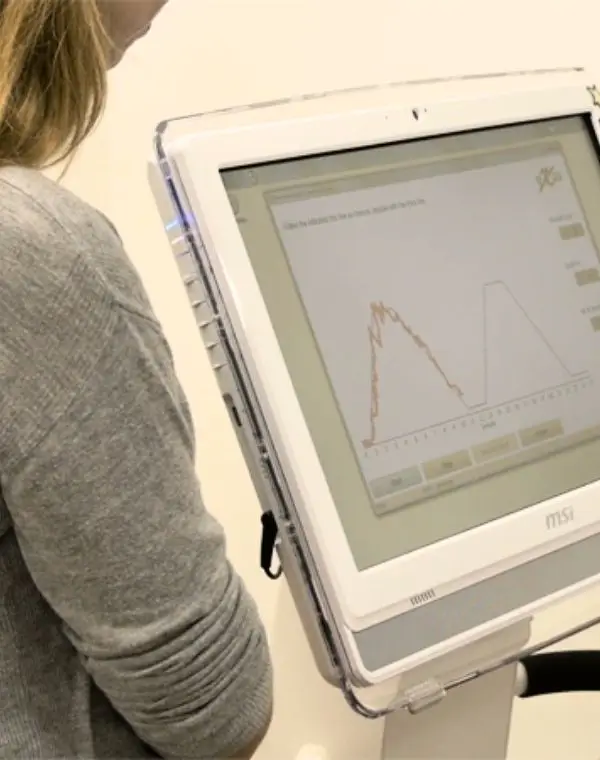
In the context of pelvic floor rehabilitation, biofeedback measures the electrical activity of the pelvic floor muscles during contraction and relaxation, and displays this as a visual signal — typically a graph, gauge, or animated display — that the patient watches during exercise. The visual feedback tells you:

  • Whether your pelvic floor is contracting when it should
  • How strongly it is contracting
  • Whether you are contracting the correct muscles or recruiting compensatory muscles (gluteals, adductors, abdominals)
  • Whether you are relaxing completely between contractions — as important as the contraction itself
  • Whether there is asymmetry between the two sides of the pelvic floor

With this information, patients learn to activate their pelvic floor correctly, efficiently, and with conscious awareness — often within a single session. The difference between practising without feedback and practising with feedback is the difference between trying to learn piano in the dark and learning it with the music clearly visible in front of you.

The Excio is not a standard biofeedback device. It represents a significant advance on conventional pelvic floor biofeedback systems in several respects:

Precision sensing. The Excio uses high-resolution electromyography (EMG) to capture pelvic floor muscle electrical activity with a level of sensitivity and specificity that distinguishes genuine pelvic floor muscle activation from compensatory recruitment of adjacent muscle groups. Conventional systems can confound these signals.

Real-time visual interface. The patient-facing display presents muscle activity in real time through a clear, intuitive visual format. Patients can see the relationship between their effort and the measured response immediately, enabling rapid learning.

Both contraction and relaxation training. Conventional biofeedback devices focus on contraction strength. The Excio provides equal feedback on the relaxation phase — critical for patients with hypertonic (overactive) pelvic floor conditions, where the ability to fully release the pelvic floor is as therapeutically important as the ability to contract it.

Progress tracking. The Excio stores session data, allowing clinicians and patients to track change in pelvic floor muscle function over time with objective measurements. This replaces subjective clinical impression with data.

Non-intimidating form factor. The device is designed to be used comfortably in a clinical physiotherapy setting without the procedural complexity of some older biofeedback systems.

LPAW is currently the only clinic in the UK to have the Excio Pelvic Floor Trainer. Patients accessing this technology at LPAW are accessing something genuinely not available anywhere else in the country.

Stress Urinary Incontinence

Leakage with coughing, sneezing, laughing, running, or lifting is caused by insufficient pelvic floor support during increased intra-abdominal pressure. The first-line treatment is pelvic floor muscle training — but only if performed correctly. Biofeedback ensures that training is targeting the right muscles, with the right activation pattern, and with measurable progression.

A 2011 Cochrane review found that pelvic floor muscle training with biofeedback was significantly more effective than pelvic floor muscle training alone for stress urinary incontinence, with a higher cure or improvement rate. This is not a marginal benefit — it is a clinically meaningful difference in outcomes.

Urgency Urinary Incontinence and Overactive Bladder

Biofeedback is used in combination with PTNS for overactive bladder patients. Where the urgency is partly driven by poor pelvic floor coordination — failure to reflexively contract the pelvic floor during urgency to inhibit the bladder contraction — biofeedback teaches this coordination directly.

Pelvic Floor Hypertonicity (Overactive / Tight Pelvic Floor)

A significant proportion of pelvic floor patients present with the opposite problem to weakness: a pelvic floor that is chronically too tight, too tense, or failing to relax. Symptoms include pelvic pain, pain with intercourse (dyspareunia), difficulty inserting tampons, urgency, and incomplete emptying.

For these patients, down-training — learning to relax and release the pelvic floor — is the therapeutic goal. The Excio’s real-time relaxation feedback is particularly valuable here: it shows the patient exactly when the pelvic floor is truly relaxed (at baseline resting tone) rather than simply less contracted than a moment ago.

This is one of the most significant advantages of the Excio over conventional systems, which often give poor feedback on the relaxation phase.

Post-Natal Pelvic Floor Rehabilitation

After childbirth — regardless of delivery mode — pelvic floor function is disrupted. The muscle may be weakened, poorly coordinated, or both. Many women find it genuinely difficult to feel whether they are contracting their pelvic floor at all in the postnatal period, particularly after instrumental delivery or significant perineal trauma.

Biofeedback gives postnatal patients the objective confirmation that the pelvic floor is contracting — removing the uncertainty and enabling targeted, effective training from the first session.

Prolapse Management

Pelvic organ prolapse — descent of the bladder, uterus, or rectum into the vaginal canal — is managed with pelvic floor muscle training as first-line treatment for Grade I–II prolapse. The Excio ensures this training is as effective as possible, maximising the strength and coordination of the pelvic floor support that reduces prolapse symptoms.

Pre- and Post-Operative Pelvic Floor Rehabilitation

Before prostatectomy or pelvic floor surgery, biofeedback ensures patients can correctly activate the pelvic floor before the surgery disrupts normal sensation and function. Post-operatively, it helps patients relearn pelvic floor activation during recovery.

Male Pelvic Floor Dysfunction

Biofeedback is equally applicable to men — particularly for post-prostatectomy urinary incontinence and chronic pelvic pain syndrome. The Excio is used for male patients as well as female, providing the same real-time muscle activation feedback for pelvic floor rehabilitation. See Men’s Health.

Biofeedback is a technique in which the body’s physiological responses are measured and displayed in real time, allowing the patient to learn voluntary control over functions that are normally unconscious or poorly perceived.

In the context of pelvic floor rehabilitation, biofeedback measures the electrical activity of the pelvic floor muscles during contraction and relaxation, and displays this as a visual signal — typically a graph, gauge, or animated display — that the patient watches during exercise. The visual feedback tells you:

  • Whether your pelvic floor is contracting when it should
  • How strongly it is contracting
  • Whether you are contracting the correct muscles or recruiting compensatory muscles (gluteals, adductors, abdominals)
  • Whether you are relaxing completely between contractions — as important as the contraction itself
  • Whether there is asymmetry between the two sides of the pelvic floor

With this information, patients learn to activate their pelvic floor correctly, efficiently, and with conscious awareness — often within a single session. The difference between practising without feedback and practising with feedback is the difference between trying to learn piano in the dark and learning it with the music clearly visible in front of you.

The Excio is not a standard biofeedback device. It represents a significant advance on conventional pelvic floor biofeedback systems in several respects:

Precision sensing. The Excio uses high-resolution electromyography (EMG) to capture pelvic floor muscle electrical activity with a level of sensitivity and specificity that distinguishes genuine pelvic floor muscle activation from compensatory recruitment of adjacent muscle groups. Conventional systems can confound these signals.

Real-time visual interface. The patient-facing display presents muscle activity in real time through a clear, intuitive visual format. Patients can see the relationship between their effort and the measured response immediately, enabling rapid learning.

Both contraction and relaxation training. Conventional biofeedback devices focus on contraction strength. The Excio provides equal feedback on the relaxation phase — critical for patients with hypertonic (overactive) pelvic floor conditions, where the ability to fully release the pelvic floor is as therapeutically important as the ability to contract it.

Progress tracking. The Excio stores session data, allowing clinicians and patients to track change in pelvic floor muscle function over time with objective measurements. This replaces subjective clinical impression with data.

Non-intimidating form factor. The device is designed to be used comfortably in a clinical physiotherapy setting without the procedural complexity of some older biofeedback systems.

LPAW is currently the only clinic in the UK to have the Excio Pelvic Floor Trainer. Patients accessing this technology at LPAW are accessing something genuinely not available anywhere else in the country.

Stress Urinary Incontinence

Leakage with coughing, sneezing, laughing, running, or lifting is caused by insufficient pelvic floor support during increased intra-abdominal pressure. The first-line treatment is pelvic floor muscle training — but only if performed correctly. Biofeedback ensures that training is targeting the right muscles, with the right activation pattern, and with measurable progression.

A 2011 Cochrane review found that pelvic floor muscle training with biofeedback was significantly more effective than pelvic floor muscle training alone for stress urinary incontinence, with a higher cure or improvement rate. This is not a marginal benefit — it is a clinically meaningful difference in outcomes.


Urgency Urinary Incontinence and Overactive Bladder

Biofeedback is used in combination with PTNS for overactive bladder patients. Where the urgency is partly driven by poor pelvic floor coordination — failure to reflexively contract the pelvic floor during urgency to inhibit the bladder contraction — biofeedback teaches this coordination directly.


Pelvic Floor Hypertonicity (Overactive / Tight Pelvic Floor)

A significant proportion of pelvic floor patients present with the opposite problem to weakness: a pelvic floor that is chronically too tight, too tense, or failing to relax. Symptoms include pelvic pain, pain with intercourse (dyspareunia), difficulty inserting tampons, urgency, and incomplete emptying.

For these patients, down-training — learning to relax and release the pelvic floor — is the therapeutic goal. The Excio’s real-time relaxation feedback is particularly valuable here: it shows the patient exactly when the pelvic floor is truly relaxed (at baseline resting tone) rather than simply less contracted than a moment ago.

This is one of the most significant advantages of the Excio over conventional systems, which often give poor feedback on the relaxation phase.


Post-Natal Pelvic Floor Rehabilitation

After childbirth — regardless of delivery mode — pelvic floor function is disrupted. The muscle may be weakened, poorly coordinated, or both. Many women find it genuinely difficult to feel whether they are contracting their pelvic floor at all in the postnatal period, particularly after instrumental delivery or significant perineal trauma.

Biofeedback gives postnatal patients the objective confirmation that the pelvic floor is contracting — removing the uncertainty and enabling targeted, effective training from the first session.


Prolapse Management

Pelvic organ prolapse — descent of the bladder, uterus, or rectum into the vaginal canal — is managed with pelvic floor muscle training as first-line treatment for Grade I–II prolapse. The Excio ensures this training is as effective as possible, maximising the strength and coordination of the pelvic floor support that reduces prolapse symptoms.


Pre- and Post-Operative Pelvic Floor Rehabilitation

Before prostatectomy or pelvic floor surgery, biofeedback ensures patients can correctly activate the pelvic floor before the surgery disrupts normal sensation and function. Post-operatively, it helps patients relearn pelvic floor activation during recovery.


Male Pelvic Floor Dysfunction

Biofeedback is equally applicable to men — particularly for post-prostatectomy urinary incontinence and chronic pelvic pain syndrome. The Excio is used for male patients as well as female, providing the same real-time muscle activation feedback for pelvic floor rehabilitation. See Men’s Health.

Meet our team of experts

LPAW’s clinical team includes 19 practitioners, many holding postgraduate qualifications from UCL, King’s College London, and Guy’s and St Thomas’. Lead clinician Mr Arjun Viswanath MSc, MCSP, MPPA – Co-Founder and Consultant Physiotherapist – brings 25+ years of NHS and private experience including BMI London Independent Hospital and Harley Street.

Every clinician joining LPAW completes a mandatory intensive shadowing placement with our Consultant Physiotherapist before seeing patients independently. This is not a standard practice at most clinics – it’s our way of maintaining clinical consistency across the team.

What Our Patients Say

From the moment I walked into this clinic, I knew everything was going to be okay. After seeing many physios, Priyanka, the pelvic specialist, was the first one to properly diagnose my back injury and choose exercises that were actually right for my condition.

I HIGHLY recommend hydrotherapy. This clinic has truly been life-changing for me. When you live with constant pain, finding real relief is priceless.

Thank you for the care, professionalism, and for giving me hope again ❤️
Molly W. profile picture
Molly W.
1 month ago
We had 6 of their amazing physiotherapist support London’s Air Ambulance Charity’s post-race reception for the 2026 London Marathon. Their communication before and during the event was excellent and all our runners have commented on how much their post-race massage has helped them with their recovery. We hope to work with them again in the future
Percy C. profile picture
Percy C.
2 months ago
Extremely impressed by the service offered. I injured my knee a while ago and they have been amazing in helping me with me recovery. Uzair Ahmed is very knowledgable and I really trust him with my recovery journey. Would highly recommend!
Ziya H. profile picture
Ziya H.
2 months ago
Been coming here for over a year every six weeks. Very professional and friendly at the same time. Can highly recommend. Big shout out to Mohammed and great reception service.
Kevin P. profile picture
Kevin P.
2 months ago
Fantastic treatment available! Enquired at short notice and they had a superfast response, and the treatment was excellent. Thank you!!
James L. profile picture
James L.
2 months ago
The team were highly professional, pleasant and helpful throughout my process of physiotherapy. I highly recommend this therapy clinic!
Em H. profile picture
Em H.
2 months ago
Had a couple of excellent sessions with Priyanka Shah, with really useful exercises and advice. Highly recommend!
Nicola W. profile picture
Nicola W.
3 months ago
Helpful and knowledgeable. Thank you!
Richard T. profile picture
Richard T.
3 months ago
I suffer with lower back disc bulges pinching my muscles and severely limiting my mobility, stability, and indeed causing agonising pain at the worst of times. I received a kind, patient and conscientious home visit at first before being invited to hydrotherapy at the clinic. 2 sessions in and I'm loving it so much, I'm determined to get one of these pools for myself later on in life. Couldn't recommend them highly enough.
Chris C. profile picture
Chris C.
3 months ago
Miracle workers!! Great gym rehab facilities patience to really understand the problem. Would highly recommend for anyone with chronic neck or back pain who are prepared to do some work on themselves.
Arif H. profile picture
Arif H.
3 months ago
Have been attending sessions for Physiotherapy here twice a week for many weeks now. Everyone is very patient and understanding. My treatment is going exceptionally well so far and Im already seeing massive progress from before my first ever session.

Would definitely recommend this clinic for anyone who needs rehabilitation or treatment!
D.Iyalla 1 profile picture
D.Iyalla 1
4 months ago
I’ve been attending London Physiotherapy And Wellness Stratford for 3 weeks now and already there are improvements in the areas I had problems with.
The physiotherapist is very knowledgeable and passionate about how he can help to improve & build your strength.
To help you recover is his main focus.
Not only is the physiotherapists customer service is great the admin team is also.
I personally recommend.
Ollie S. profile picture
Ollie S.
4 months ago
I had to visit the clinic for a hip injury I received from running. I started physio with Anup back in November and started with hydrotherapy, moving into physio in the new year. I've had a great experience with Anup and now I'm well on the road to recovery, I've started running again and I know what strength workouts I should be doing to keep up my recovery. So glad I found Anup and the clinic and would recommend them to anyone who has an injury!
无颜Music profile picture
无颜Music
4 months ago
The location is really convenient for me. The physiotherapist was very knowledgeable. He helped me identified the root cause of my heel pain and provided me with a clear pathway to my recovery.
Will recommend them ????????
Ervis L. profile picture
Ervis L.
6 months ago
I was assisted by Priyanka while recovering from a torn quad, and I couldn’t have asked for a better physiotherapist. She was incredibly supportive during a moment of real vulnerability, and I always felt truly taken care of. Her focus during every session was exceptional she even kept counting my reps to make sure I stayed on track!

Priyanka is a wonderful asset to the team, and I feel very lucky to have had her during my recovery. Highly recommended.
andrea B. profile picture
andrea B.
8 months ago
Best Physio ever. I visited the clinic after I damaged the ACL ligament practicing judo. I was unable to walk, using crutches and couldn't bend the leg. I was initially told by the doctor to wait at least 6/7 months to be fully recovered and the physiotherapy was the only way to get better. Thanks to the skilled clinic and very professional physiotherapist, they managed to get me back on trainings after 3/4 months only having now a stronger knee than before. I was assisted my Mohammed N R and his job was beyond the expectations. They have specific equipment to practice a high variety of exercises and furthermore they are super friendly and easy reachable by email or phone for last minute doubts. I cannot thank more for the assistance received for a faster recovery they granted me. I fully recommend them.

Frequently Asked Questions

Almost certainly yes. Research shows that a large proportion of women doing long-term pelvic floor exercises have been performing them incorrectly without knowing it. Biofeedback frequently reveals compensatory patterns — patients who are contracting their gluteals or holding their breath rather than truly activating the pelvic floor. Correcting this often produces rapid improvement in patients who have seen little benefit from years of self-directed exercise.

No. The sensor is small and well-tolerated by the vast majority of patients. Your clinician will apply a sterile sensor and insert it gently. If at any point you find it uncomfortable, the session can be adapted. An alternative external electrode option is also available.

Yes. The Excio is used for male pelvic floor assessment and rehabilitation using a rectal sensor. It is particularly applicable to post-prostatectomy rehabilitation and chronic pelvic pain syndrome in men. See Men’s Health.

Consumer biofeedback devices (Kegel trainers, pelvic floor app devices) provide basic muscle contraction signals but lack the clinical sensitivity to distinguish true pelvic floor activation from compensatory muscle recruitment, and are not designed to provide meaningful feedback on the relaxation phase. They also come without clinical assessment, personalised programming, or expert guidance on what the feedback means. The Excio is a medical-grade clinical device — in a different category from consumer products.

No. You can self-refer directly. Biofeedback is delivered within a pelvic health physiotherapy assessment — contact us to book. See our Women’s Health or Men’s Health pages for more information.

Yes — as of our most recent information, LPAW holds the only Excio Pelvic Floor Trainer in clinical use in the United Kingdom. This is not a standard piece of physiotherapy equipment. We invested in the Excio because we believe our pelvic health patients deserve the best available technology — and because the clinical outcomes it enables are better than those achievable without it.

How It Works At LPAW

What To Expect

Sessions are typically 30–45 minutes as part of a broader physiotherapy appointment.

The Excio device uses a small vaginal or rectal sensor to measure pelvic floor EMG activity. The sensor is comfortable and non-invasive in the usual clinical sense — it is similar in size to a standard tampon. For patients who prefer not to use an internal sensor, surface electrode alternatives can capture a proportion of the signal.

Your clinician will explain the device and the session format before beginning. You will watch the visual display on the Excio screen as you perform exercises, with your clinician guiding your technique based on what the feedback shows.

Most patients find it immediately illuminating — seeing an objective display of their pelvic floor activation for the first time is frequently described as the point at which pelvic floor rehabilitation begins to feel genuinely purposeful.

Biofeedback is not a standalone service — it is a tool within a comprehensive women’s health or men’s health physiotherapy programme.

A typical integrated pathway for a patient with stress urinary incontinence:

  1. Initial pelvic health assessment — history, examination, diagnosis, and baseline symptom scoring
  2. Biofeedback session 1 — establish correct pelvic floor activation pattern using the Excio; correct any compensatory strategies; set home exercise programme based on what is confirmed as correct technique
  3. Progressive sessions — increasing exercise load (duration, speed, functional positions) with Excio feedback to confirm quality and track progress
  4. Functional integration — pelvic floor activation integrated with activity (standing, walking, lifting) with biofeedback confirmation
  5. Independent programme — once correct technique is established, home exercise continues independently; clinic sessions used for reassessment and progression

For patients with concurrent urgency requiring PTNS, the two treatments run simultaneously — PTNS addressing the overactive bladder neural pathway while biofeedback addresses pelvic floor muscle coordination.

How It Works At LPAW

Sessions are typically 30–45 minutes as part of a broader physiotherapy appointment.

The Excio device uses a small vaginal or rectal sensor to measure pelvic floor EMG activity. The sensor is comfortable and non-invasive in the usual clinical sense — it is similar in size to a standard tampon. For patients who prefer not to use an internal sensor, surface electrode alternatives can capture a proportion of the signal.

Your clinician will explain the device and the session format before beginning. You will watch the visual display on the Excio screen as you perform exercises, with your clinician guiding your technique based on what the feedback shows.

Most patients find it immediately illuminating — seeing an objective display of their pelvic floor activation for the first time is frequently described as the point at which pelvic floor rehabilitation begins to feel genuinely purposeful.

Biofeedback is not a standalone service — it is a tool within a comprehensive women’s health or men’s health physiotherapy programme.

A typical integrated pathway for a patient with stress urinary incontinence:

  1. Initial pelvic health assessment — history, examination, diagnosis, and baseline symptom scoring
  2. Biofeedback session 1 — establish correct pelvic floor activation pattern using the Excio; correct any compensatory strategies; set home exercise programme based on what is confirmed as correct technique
  3. Progressive sessions — increasing exercise load (duration, speed, functional positions) with Excio feedback to confirm quality and track progress
  4. Functional integration — pelvic floor activation integrated with activity (standing, walking, lifting) with biofeedback confirmation
  5. Independent programme — once correct technique is established, home exercise continues independently; clinic sessions used for reassessment and progression

For patients with concurrent urgency requiring PTNS, the two treatments run simultaneously — PTNS addressing the overactive bladder neural pathway while biofeedback addresses pelvic floor muscle coordination.

Ready to bounce back better?